Cost Models & Sizing
Plane Community Microservices RAM Budget: Django, Celery & Next.js
Breakdown of real RSS memory consumption across api, worker, beat-worker, web, space, admin, Postgres 15, Valkey, and MinIO from 10 to 350 seats.
2.8 GB RSS (15 seats) -> 5.2 GB RSS (120 seats) -> 9.4 GB (300 seats)
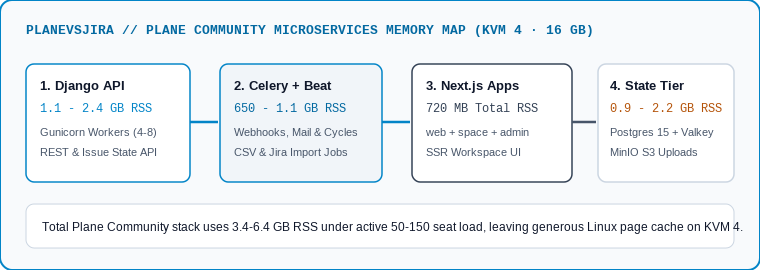
Accounting for Every Container in Plane Docker Compose
Unlike single-binary trackers, Plane runs 9–10 coordinated containers: Django api (Gunicorn), Celery worker + beat-worker, three Next.js SSR apps (web, space, admin), Postgres 15, Redis/Valkey, MinIO S3, and a reverse proxy.
Matching Node RAM Tiers Without OOM Kills
At 10–50 seats, total steady-state RSS sits near 2.8–3.8 GB (safe on KVM 2 8 GB or KVM 4 16 GB). Between 50–180 seats, KVM 4 (16 GB) provides ample page cache. Above 200 seats, KVM 8 (32 GB) prevents Gunicorn worker swapping.
36-Month Cost & Microservices Breakdown
| Plane Container Service | 15 Seats (KVM 2/4) | 100 Seats (KVM 4) | 300 Seats (KVM 8) |
|---|---|---|---|
| Django api (Gunicorn) | 780 MB | 1,300 MB | 2,080 MB |
| Celery worker + beat | 560 MB | 890 MB | 1,650 MB |
| Next.js (web + space + admin) | 720 MB | 780 MB | 900 MB |
| Postgres 15 + Valkey + MinIO | 790 MB | 1,180 MB | 2,120 MB |